Chef Adam Busby of the Culinary Institute of America
There were 411 people registered for the course, coming from 35 states, and internationally from 29 countries. Including spouses, faculty, chefs, and exhibitors, more than 550 people attended. For those registered, 59% were physicians, 11% nutritionists, 5% nurses & nurse practitioners, 5% masters of public health, and 20% others (chefs, psychologists, physical therapists, exercise trainers, physician assistants). The majority of physicians were internal medicine and family medicine, but also pediatrics, OB/GYN, sports medicine, psychiatry, anesthesiology, cardiology, endocrinology, and surgical specialties. A diverse group, indeed.
We had lectures from top notch physicians, dieticians, chefs, and others. Many were book authors. I already made a couple of recipes from Suvir Saran autographed book.
Dr. Eward Phillips talking about exercise.
They fed us well, with something like 350 different healthy dishes to try.
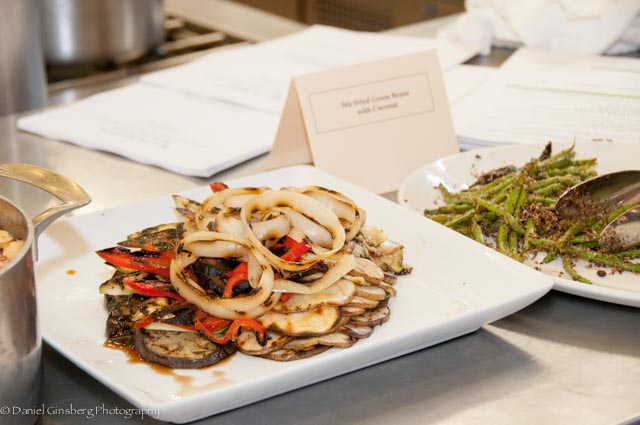
We also had a hands on kitchen session, then ate our own cooking.
Chef Thomas Wong
Now the challenge is how to use all the information and get my patients to eat healthier. As a start, I’ve posted some healthy recipes on Pinterest.
This is the time of year people make New Year’s resolutions. Many goals get made repeatedly each year because it’s hard to sustain changes in habits to make progress in things like losing weight. People start off good, but a year is a long time.
If you are trying to lose weight, stop smoking, exercise regularly, or achieve some other goal that eludes you, try making a resolution to do those things for the month of January. It’s a lot easier to do something (or not do something) for a month, than to keep it up for 365 days.
At the end of the month the work you’ve done towards your goal may have almost turned it in to an ingrained habit, making it all the easier to make a resolution for February, an even shorter month.
With two months under your belt, you are well on your way. Happy New Year!
The FDA is proposing a new rule in regards to tobacco regulation. As detailed recently in the New York Times, the benefits of stopping smoking, such as less heart and lung disease, would need to be discounted 70%, making it that much harder to justify spending money on smoking cessation. It sounds like something inserted at the bequest of tobacco lobbyists. Tomorrow is the deadline to make a public comment. Here is what I submitted:
I think it’s a dire mistake to discount the economic and health benefits of stopping smoking because of the loss of enjoyment. Although smokers may get temporary enjoyment from smoking, they also get enjoyment from being healthy. Surely one gets more pleasure taking a walk in a park and living at home, than pushing an oxygen tank down a hall in a nursing home because of severe emphysema. Smokers die at a younger age than they otherwise would. What about the enjoyment their partners, children, and grandchildren lose when the smoker dies prematurely? Loss of enjoyment should not be part of the equation, unless it’s a negative number which would serve to magnify the cost smoking places on individuals and society.
If you apply for health insurance, you may find you have to pay higher rates if you’re a smoker. Now federal regulators are trying to decide if insurers who participate in the Affordable Care Act (aka ObamaCare) exchanges can add a surcharge for those using e-cigarettes or vaporizers. They already can for cigarettes in most states.
Some argue against this, in the name of harm reduction, the idea that if people are going to smoke, it’s better to smoke something safer. For example, Reynolds American Inc spokesman David Howard, said, “We don’t believe policies should be implemented that might deter current smokers from considering switching to smoke-free alternative products like e-cigarettes.”
Numerous studies have, shown, however,that the best way to get people to cut back on smoking, is to make it more expensive. E-cigarettes and vaporizers are cheaper than cigarettes, so paying more for insurance for all forms will encourage more people to stop smoking. No one is suggesting that those smoking alternative forms of tobacco be charged more than those who smoke cigarettes, so even if insurers charge extra for those who use e-cigarettes or vaporizers, they will not pay more than if they stuck with cigarettes, so really it won’t deter smokers from switching. People switch because it costs less, it’s more socially acceptable, or they perceive it to be safer.
In that last regard, vapor may be safer than cigarettes, but we really don’t know. Recent studies show they can definitely have known carcinogens, such as formaldehyde. Would you really want to inhale a chemical used to embalm corpses? I tell my patients that if they use e-cigarettes to help them quit smoking, which may or may not help, then I’m alright with that, but the goal should be to stop using tobacco products, and not just switch from one habit to another.
This study looked at 834 men diagnosed with prostate cancer, and compared them with 1393 men, matched for age and race, that did not have prostate cancer. They then looked at the amount of omega-3 in their blood and compared the groups.
They found that those with the highest omega-3 levels had the highest risk of prostate cancer, 44% higher over all. This study followed up on one published earlier by the same group that suggested increased risk from fish consumption. The levels of omega-3 in the highest group were fairly modest, equivalent to eating an oily fish, such as salmon, twice a week.
Before jumping to the conclusion that men should not take fish oil or consume much fish, there are a number of things to consider. First of all, association does not imply causation. What does that mean? Just because two things occur together, it does not mean that one caused the other. If you look outside on a rainy day, you will see many people carrying umbrellas. But you would be wrong to conclude that carrying umbrellas caused it to rain.
It could be that it wasn’t the omega-3 in fish, or fish oil supplements, that caused prostate cancer, but rather something else in the products, such as mercury or other toxins in the fish. If you ate fish raised in places low in pollution, or consumed ultra-filtered fish oil, then perhaps it would not be a problem. This study does not answer that question.
Even if eating fish or taking supplements increases the risk of prostate cancer, studies have shown it decreases the risk of cardiovascular (heart) disease, which is far more common.
This study was not the preferred double-blind, placebo controlled study, and the conclusion may just be wrong. After all, other studies have shown that fish consumption decreases prostate cancer. For example, one in the Lancet showed decreased risk of prostate cancer in those who ate moderate or high amounts of fish. Also consider that Japanese men consume much more fish then American men, yet have far less prostate cancer.
So until I see more convincing evidence, I’ll continue to take my fish oil capsules, and enjoy eating salmon.
Food companies use sophisticated science and psychology to get people to buy their food. Using combinations of salt, sugar, and fat, among other things, they entice us and cause actual addiction. Although many people are rightfully concerned given the levels of obesity, diabetes, and other health problems, I think they’re missing out on a segment of the population that might actually benefit from their craft.
Not infrequently do I see patients, often elderly, who have a problem many of us could only wish for. They have a poor appetite. This may be due to many factors, including diminished smell and taste, poor vision, and dry mouth. What they need is food meant to appeal to them.
One of the tricks used to sell us more food is vanishing caloric density. Foods like Cheetos, that quickly melt in the mouth, fool the brain to think there are less calories than there really are, so people eat more of them. If you’re malnourished, that might be a good thing. The food engineers should create foods that people with a poor appetite will actually want to eat. Throw in some vitamins and fiber, and just maybe they would get physicians to recommend them.
The Chinese are less concerned about safety than American. We worry about health risks, perhaps obsessively at times, but from my perspective it’s less of a concern to them. As I wrote, I thoroughly enjoyed a recent trip to China, but now want to discuss some observations on medical issues in China.
Smokers at tables flanking a no smoking sign in a Beijing restaurant.
They smoke much more, and allow smoking in many more places. No smoking signs are often ignored.
In some of their cities, they breath in much more pollution. The Chinese government publicly posts measurements of the air quality, but it’s often significantly less than the United States Embassy measurements. Here are readings I recorded during our trip.
China Air Quality Shanghai – Official ReadingChina Air Quality Shanghai – US Consulate
This score of particulate matter was created by the Environmental Protection Agency and goes up to 500, which was supposed to be the scale maximum. Recently readings in Beijing have been as high as 755. According to China’s Ministry of Environmental Protection, less than 6% of vehicles in the country meet the highest environmental standards, and there is particularly a problem with the tiny particles known as PM2.5, thought to be particularly toxic. Most of this is generated by older cars and trucks.
Bicycle and motor scooter riders don’t wear helmets. In 3 days of driving around Beijing our guide never wore seat belts, even on the highway. The driver only wore it one time briefly. Eighty percent of car sales are to first time buyers, and many of them have little experience. Pedestrians do not have the right of way. One evening we drove past a man crumpled up on the street, with a man standing next to him talking on the phone, and no ambulance in sight. I can’t be certain, but I believe he was hit by a car trying to cross the street. Shortly after leaving our hotel in Shanghai on the way to the airport, our bus was temporarily stopped in traffic after a motorcyclist was hit and was laying on the ground. If we saw two people hit in 8 days, imagine how often it must occur.
They seem to be less germaphobic than most Americans. Their tap water is not potable unless you’ve lived there long enough to have developed resistance. They eat family style sharing multiple dishes, but do not give serving utensils, so everyone dips their own chopsticks into the common food.
According to an article in the 11/14/12 China Daily newspaper, obesity is becoming more common in Shanghai. It said that roughly 40 percent of adults in Shanghai are obese or overweight. A survey released at the end of 2011 showed the average weight of male residents had increased by 2.9 kg (6.4 lbs), and weight circumference had increase 2.3 cm (0.9″) since 2000. Certainly they have much less obesity than we do in the United States, but it’s likely to get worse. They are less physically active, with motor bikes more common than bicycles, and their diet is getting more westernized. I saw many McDonalds, Haggen-Daz, and Starbucks in Beijing and Shanghai.
Another article in the same issue said the number of people in mainland China with diabetes has doubled in the past decade to about 9.7% in those 20-years-old and older, and that only 40% of them have been diagnosed. Because of the increase in chronic illnesses there, pharmaceutical company Eli Lilly & Company plans to expand in China to increase sales of their drugs for diabetes, the heart and cancer.
We went to the China Academy of Chinese Medical Sciences at the Science and Technology Center (www.china-tcm.com). While our feet soaked in a tub of tea, someone came and talked about the center. It was started in 1955 under the direction of Mao Tse Tung. It mostly serves the government leaders. He said none of them have heart problems, cancer or high blood pressure. He said only Chou Enlai had liver cancer in 1976 when they were less developed. Next students massaged our feet while a doctor examined me, then my wife, while a woman translated. He felt the pulse with 3 fingers check on each side. He said I had problems with blood pressure and fatty liver and said I should lose 5-6 kg. I’ve not had problems with the first two, but wouldn’t argue with the last. He also asked if I had an eye problem. I actually have had some problems with eye inflammation, but perhaps he looked in my eyes and noticed the affect of a combination of air pollution and jet lag. He recommended 2 medicine, each ¥650 (about $100) for a month supply and said I needed to take it for only 1-2 months. He said I would be amazed at the difference. When I hesitated he asked if my patients take their medicine when I prescribe it. I ended up buying a one month supply for myself as I felt a little guilty they had spent all the time on us, and it was place that didn’t seem to get many foreigners. I figured if for nothing else, it would make a good blog post. In my n-of-1, non-blinded, non-placebo controlled study, I found no difference after taking the medications for one month. Well actually I did lose about 3 lbs, but I suspect that was from following my New Year’s resolution with more exercise and an even better diet. Considering that I felt the same, despite being a month older, maybe it did do something.
Although I joke about it, I suspect some herbal medicines are effective. After all, some pharmaceutical medications in use today are derived from plants. Before taking such medications long term, one should be concerned about not only effectiveness, but safety, including the risk of contamination with lead and other chemicals.
I was going to try acupuncture, but our guide couldn’t find a place she felt comfortable recommending (sterile needles, etc.).
Prior to the trip I obtained a hepatitis A vaccination. That’s the one viral hepatitis that can be transmitted by contaminated food, which although it doesn’t caused a chronic infection, can definitely put a damper on your vacation.
China seems to be moving in the right direction in some areas related to health and the environment, which I hope they sustain. They don’t need to adopt all the practices of Western society, nor would I wish them to do so, but the Chinese people shouldn’t needlessly suffer from from such things as traffic fatalities, pollution, and smoking, and those things should minimized as much as possible.
A patient of one of my colleagues, away on vacation, came in for a problem he was having. We were in a fairly severe flu season and I noticed he had not been vaccinated. I asked him if he wanted a flu shot and he replied that he can get it for free at work. When I asked him if he was going to get one, he said no, that he didn’t believe in flu shots.
Last week I wrote about the 1st Amendment. This week I’m going to talk about the 2nd. There is an epidemic of gun violence. This is a serious health problem. Watching your diet, exercising, and taking pills is all for naught if a bullet kills you.
In Newtown, Connecticut, one of the worst mass shooting occurred last week when a gunman shot his mother at home, apparently with her own gun, then walked into an elementary school and shot 6 other adults and 20 children, before shooting himself. Gun rights are hotly debated and highly politicized, but gun violence is a serious health issue. The National Rifle Association (NRA) and others have been strong proponents of gun rights, and have fought hard to fight off attempts for even the slightest form of control, including restrictions on semi-automatic and assault weapons.
One of their arguments is that citizens can protect themselves with guns, and that concealed guns are a particularly effective deterrent because potential assailants won’t know who may be armed. But in 61 cased in the US in the past 30 years, maybe only one was stopped by a gun other than their own, or by the police. Even if people want guns to protect themselves, they shouldn’t need to cover the contingency of an invading army, so I see no need for high capacity bullet magazines.
Many mass shooters have mental illness and we need to do a better job providing access to mental health treatments. Some illnesses, such as schizophrenia, often don’t really manifest until people are in their teens or early 20’s, allowing them to purchase guns when their sick enough to do real damage, but not so severe that they would have more trouble planning an attack or convincing someone to sell them a gun. Even if not mentally ill, young men tend to act less rashly as they get older, and are more likely to consider the consequences of their actions. From a list of 22 of the deadliest mass shootings around the world, 65% of them were under 30. We already have a law that says that people can’t buy alcohol until they are 21-years-old, even though they can vote and serve in the military at 18-years-old. Perhaps the right to own a gun should only be allowed for those who are at least 30-years-old.
We need to close legal loopholes, such as sales between private buyers, that allow people to avoid background checks before purchasing guns. I need to fill out more paperwork to prescribe shoes for a diabetic than to buy an assault weapon. We need people to speak up and let our politicians know that gun violence caused by guns is not acceptable. We’ll never prevent all such tragedies, but we should try to minimize the possibility as best we can.
The Food and Drug Administration (FDA) has ruled that pharmaceutical companies cannot promote drugs for purposes other than the reasons for which the drug was approved. Physicians are free to do such off-label prescribing, however the drug companies cannot suggest in any way that physicians and other prescribers do so.
Companies have to do expensive studies to show that a medication is both safe and effective. How the FDA approves the drug is based on the research the company did. For example, Neurontin (gabapentin) is approved for certain kinds of seizures, post-herpetic neuralgia, and neuropathic pain. In 2004 Warner-Lambert paid $430 million in a court case brought by the government for off label use. The pharmaceutical company sales representatives had, promoted it for conditions including bipolar mental disorder, Amyotrophic Lateral Sclerosis, attention deficit disorder, migraine, and other conditions.
Some of those claims were true, and the company later received the nerve pain indications that it didn’t originally have. Physicians may rightly prescribe the medication without it having an indication because they have reasons to believe it may work based on the pharmacology or published studies. The pharmaceutical company may just not have been able to get it approved yet, or if it’s not a common problem, they may decide that financially it’s not worth the cost of getting an indication.
When a physician prescribes a medication, there is usually no direct economic benefit to them, and whether they are right or wrong, they will prescribe a medicine because they think it will benefit the patient. That’s not necessarily true of pharmaceutical companies, though. They have a direct economic incentive to sell as much of their product as possible, and their sales reps are often compensated on how many prescriptions the doctors they call on write. So although many of the reps are ethical, economic pressures are a strong incentive to get them to push for off label uses. Multi-million dollar settlements help hold those pressures in check.
Recently a three-judge panel of the Second Circuit Court of Appeals, in a case involving pharmaceutical sales rep Alfred Caronia, ruled that the FDA regulations violated the First Amendment’s guarantee of free speech. In an editorial the Wall Street Journal sided with the court, saying that, “health regulation is by nature health coercion.”
The Wall Street may smack down anything at all related to the Affordable Care Act (ObamaCare), but I think they are wrong. I’m not a lawyer, and much less a constitutional one, but I think of free speech in a different way. I don’t think selling a product is free speech. Selling an idea is. If you are not allowed to put up a sign touting you believe or don’t believe in God, for example, then your right to express your opinion is being abridged. If, however, you put up a sign saying the price of gasoline at your station, that’s not stating what you believe in, that’s just advertising. Granted, some cases might be fuzzy and I would err on the side of free speech, but sales reps talking about their medications are usually just advertizing. In fact the FDA does allow companies to support off label use, but it’s strictly limited (done by a physician in response to questions, etc.).
The Supreme Court acted in a similar manner in 2010 when they removed some limitations to political causes, allowing unlimited donations. This led to over a billion dollars donated in the last presidential cycle. It was done in the name of free speech, but because they could blanket the airwaves with ads, I’d argue those with less money basically lost some of their free speech to rich donors.
A lot of taxpayer money is spent on prescription medications. Busy physicians don’t have time to fact check every thing pharmaceutical sales reps tell them. Allowing reps to say whatever they want, in the name of free speech, is not good for anyone’s health, other than perhaps that of the pharmaceutical companies.














 World's Best Site - Thoughts on Medicine and Other Topics