
A patient of one of my colleagues, away on vacation, came in for a problem he was having. We were in a fairly severe flu season and I noticed he had not been vaccinated. I asked him if he wanted a flu shot and he replied that he can get it for free at work. When I asked him if he was going to get one, he said no, that he didn’t believe in flu shots.
Author: Daniel Ginsberg, MD, FACP
I'm an internal medicine physician and have avidly applied computers to medicine since 1986, when I wrote my first medically oriented computer programs. So yes, that means I'm at least 35-years-old!
PhRMA Two-Step Dance
 As part of my practice I conduct research studies for pharmaceutical companies. In order to get medications approved by the Food and Drug Administration, companies need to do studies to prove the medications are safe and effective. Studies are often conducted by multiple physicians around the world in order to get a sufficient number of patients, and to help them get the drugs approved in many countries.
The kinds of studies I do are mostly big and fairly complex endeavors. They usually have an investigator meeting prior to starting in order to explain the study, how to enroll patients, ship blood samples, order supplies, and many other details. It’s also a chance to ask questions and meet others involved in the study.
Pharmaceutical companies pay a certain amount of money to each practice for helping them do a study. That money is used for a number of things, including paying for staffing, and usually a small stipend to patients to cover their transportation and time. The budget includes money for investigators, such as myself, to attend investigator’s meetings, but unless it’s a local meeting, I make less money than I would just seeing patients in my office. A trip to the East coast takes about 3 days including the travel time each way, but I only get paid for the one day. It’s a nice change of pace, though, and it’s fun if I get to go to a city I’ve never been to before, or enjoy visiting.
Recently I was invited for the first time to an international meeting, in Vienna, Austria, by Novo Nordisk. I’d never been there so I figured I’d go a few days early to see the city. I called to book my flight but was told I could only travel the day before the meeting and return the evening of the meeting, or at most the next day. I explained that I intended to pay for the extra hotel nights and food expense, and it wouldn’t cost them any additional money. They said that they could not because of PhRMA guidelines which I’ve discussed before. They said if I arrived early they would not pay for my flight there. The concern was that they would violate the guidelines because if I spent more time at the destination than necessary, they would essentially be paying for a vacation. I pointed out that arriving early would be to their benefit as I’d be less jet lagged while attending the meeting. I also said that if I was taking a vacation, I would bring along my wife, stay for a couple of weeks if going that far, and I wouldn’t visit Vienna in the middle of the winter.
Going to Vienna I want to waltz, but PhRMA wants me to do the two-step, straight there and back. Well I have better things to do with my life, so they will need to find another dance partner.
A Vacation to China
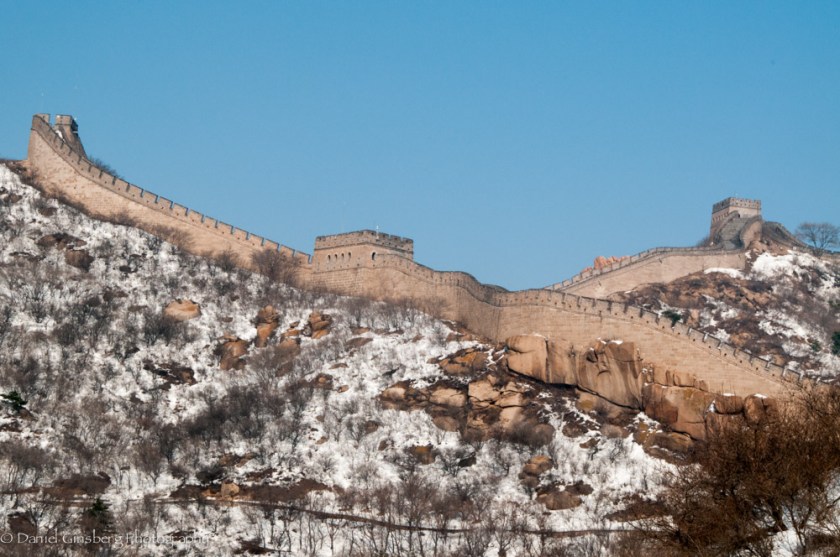
Last November I went on vacation to China. In a subsequent post, I’ll write about health issues in China, but for now I’ll just talk about the trip for those interested.
Why China, you might ask? Well I’ve always been curious, and had only been to Hong Kong about 20 years ago, and when a great deal came up, I couldn’t pass it up.
Through Travelzoo I learned of a tour from SmarTours. For an incredible $1099 per person, we had airfare on Air China from San Francisco to Beijing, 5 nights in a nice and well located hotel, a flight to Shanghai, 3 nights in a nice Holiday Inn, also well located, western and Chinese breakfast buffets in the hotels, the flight back to San Francisco, via Beijing, and all airport transfers with an English speaking guide. Additional tours were all optional, but I later learned that the trip was so cheap because it was subsidized by the Chinese government. The tours most people took stopped at government owned stores (silk factory, jade store, pearl store, etc.). As the guide told us, the Chinese government has lent a lot of money to the US, and they hoped us tourists would spend some of it in China!
In Beijing we opted to go with another tour company, recommended by a flight attendant we know, www.chinatour.net. I actually emailed them what I wanted just before getting on the plane. When we arrived at the hotel and I could get on the internet, I confirmed the email they had sent while we were in the air. Our guide called at 10:30 pm and we agreed to meet in the lobby at 8:30 the following morning. We took a private tour for the first 3 days. For a cost of ¥3000 ($484) for two people, we had a driver and tour guide, lunch and most admission fees. The first 2 days events lasted over 12 hours, with the driver waiting to drive us back after acrobatic and Kung Fu shows. For lunch the second day we paid a small surcharge to have a higher quality meal as we had them modify one of their itineraries.
The first day our guide and driver met us at 8:30 am. We went to Tiananmen Square and the Forbidden City. Because the 18th National Congress of the Communist Party of China was about to start to select the new president, security was tighter than usual, and some

buildings were closed to the public. Our guide helped us get through lines faster. Next we went to a demonstration silk factory and store, then the Temple of Heaven.

We hadn’t asked, but our guide then brought us to an enjoyable tea ceremony where we were served five different kinds of tea. There was a “pee boy” to test the water temperature. If you pour cool water on top of the head, nothing happens. But if suitably hot, the ceramic boy pees.Then we went to a Chinese acrobat show. Our guide purchased the tickets then took us to the entrance. The ticket taker tried to direct us to the 2nd floor, but when our guide said, ‘what?!’ he pointed us to much better first floor seats near the front.
Rather than go to the chain Quanjude for a Peking duck dinner, as part of the company’s tour, I opted for DaDong, which was well worth the extra cost. In addition to roast duck with condiments, we ordered peas, soy soup, and pomegranate salad.
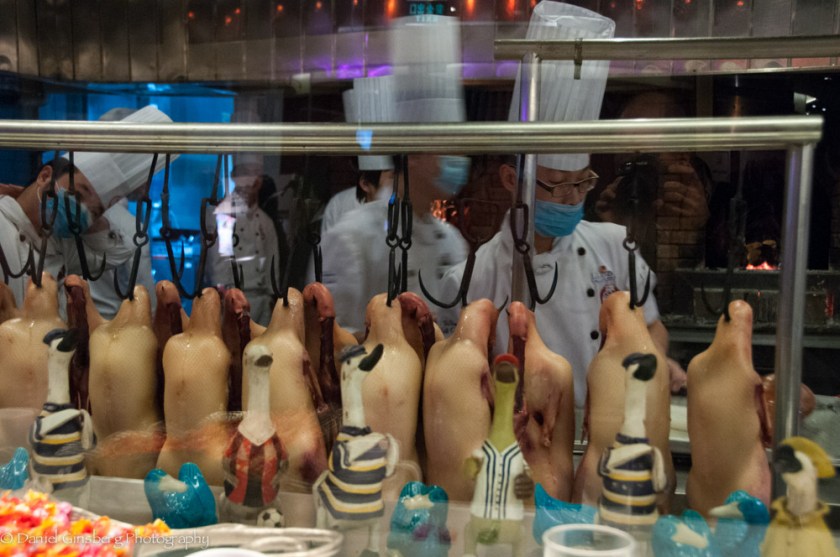
- One of the best places for Peking Duck, DaDong restaurant in Beijing.


Without us ordering they also brought persimmon and candied crab apples. This was epicurean Chinese food fit for a foodie. At ¥288 ($46) for two, it was a bargain. Our guide sat across the table waiting for us as the driver had already left to park the car. It seemed a little strange, but she helped with ordering and explaining things.
On our second full day, our guide and driver took us to the Cháng Ling tomb of the Ming Tombs.We then stopped at a jade store, followed by lunch. Then it was off to the
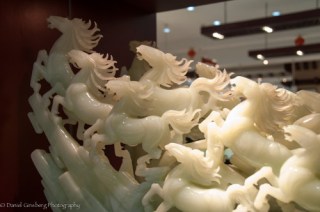
Great Wall at Badaling. Despite being off season, it was pretty crowded, but definitely worth seeing. We were lucky with the weather. It had snowed a couple of days earlier, which prevented some tour groups from going, but it was nice and sunny for us. Afterwards I went to use the toilet before leaving. I pressed what I thought was a peddle on the floor to flush the toilet. When I heard a loud sound I looked again at the peddle and realized it said “SOS”. I then found the real flush handle and made a hasty retreat!
On the way back our guide had us stop at the Derun Pearl Gallery. They have the distinction of being located at the National Olympic Sport Center, apparently because the owner or developer owned some of the land before it was turned into the center.
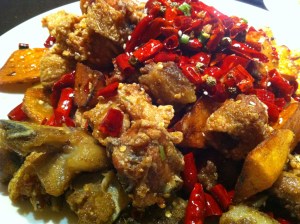 Next it was time for spicy Szechuan food before attending the Legend of Kung Fu show. The story was a little campy, but it was enjoyable.
We asked our guide about housing. She said most people pay off their house or apartment in 2 or 3 year, longer if it’s a real expensive place. They don’t take loans for cars and pay cash.
The following morning it was off to the picturesque Summer Palace. In the afternoon we strolled down the Fuxiang Hutong. That evening we walked around a mall near our hotel. I was surprised by temperature extremes. On the bottom floor was an ice skating rink, yet in the stores it was much warmer than typical American malls. I felt hot with my jacket off, yet most Chinese kept their coats on and appeared comfortable.
We went to dinner at a restaurant near our hotel. As we found at most of the restaurants we went to, the waitress stood waiting to take our order as soon as they brought us to the table, before we had even removed  our coats, much less looked at the menu. The menu had many pages, and it was not always easy to figure out what a dish consisted of with their English translations (Heavenly dragon meat, anyone?). One dish I was surprised to see was sweet potatoes with blueberry sauce. It was kind of bland, but it sure looked good.
The next day we spent most of the day at the Hongqiao (Pearl) Market. That was more time shopping then I bargained for, but it was interesting and we obtained some good deals. You do have to bargain aggressively. One saleswoman grabbed my wife’s arm to prevent her from leaving, and I literally had to pry her fingers off!
The following day a bus took us to the airport, and it was off to Shanghai. After checking in at our hotel, we went to the People’s Park then the Shanghai Museum.
The next morning we took the metro (subway) to see the Yùyuán Gardens and nearby stores. From there we took a taxi to the Bund. The distance was not far, but the man at the hotel desk suggested not walking as he said that area has a lot of pick pockets. The Bund is an elevated walkway by the water, which gives a great view of the Pûdong New Area financial district across the water, and an amazing skyline. To get across we took the Bund Sightseeing Tunnel. It was not nearly as fantastic as they made it out to be (unless perhaps you’re an 8-year-old boy), but it got us there. We stopped at the Apple Store there before going to the Shanghai World Financial Center, where we went to the 100th floor observatory for a stupendous view.
Another metro took us to the French Concession part of town. We walked a fairly long distance to go to the Bâoluó Jiûlóu restaurant. My Lonely Planet guide said it was a large 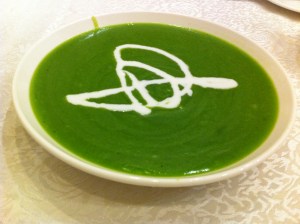 and lively place. When we got to the address all we saw was what looked like a small, dumpy restaurant. We almost left, but then walked in and asked for a table. We were taken around the corner only to discover a very large room full of people. I enjoyed a thick pea or soy (?) and coconut soup.
The next day it was off to the town of Suzhou. The train station was close to our hotel, but we wasted a half hour in the wrong building before finally finding the place we had to go to buy the tickets. Fortunately they had a line for English speakers. Unfortunately we found out that we needed to show our passports just to purchase a ticket, though it wasn’t needed to board the train. So we had to go back to the hotel to get our passports. It was a fast train that took us to Suzhou, and the landscape blurred past. When we arrived at the station, we weren’t sure where we were in relation to the town, and our guidebooks made no suggestions. At the “Information” booth the attendants barely spoke English. They suggested a 30 minute bus ride. We and two others in our group decided to take a taxi. It turned out to be a 5-10 minute ride that only cost less than $2!
We went to the zen-like Suzhou Museum, designed by architect I.M. Pei. It contained modern art (some paintings were labeled with dates such as, “2011 AD” just in case you thought it might be 2011 BC), ceramics, jade, textile, and other pieces.
 Afterward we went to the Humble Administrator’s Garden. This is a very large, and not so humble, garden, with lots of water features and Asian buildings. We had lunch at a noodle shop then wandered down the colorful Píngjiang Lù road. One had to watch out for the numerous bicycles and motorbikes.
In the evening we took the metro to East Najing Road and walked down the heavily neon-lit road. We were surprised to see a large group of mostly women doing a form of a line dance, as well as some smaller groups ballroom dancing.
We had dinner at the Lost Heaven restaurant, a large and delightful place serving Bai, Dai and Miao folk (Yunnanese) cuisine. We ate tofu with eggplant, a shrimp dish, Burmese chicken curry, and a pumpkin truffle soup. This was the most expensive restaurant of the trip at about $100 per person. But the rest of the meals were cheap, and if you’re a foodie, it’s worth it to try a delicious, and hard to find cuisine.
We ended our sightseeing with another trip to the Bund to see it at night. We took our photos just in time, before discovering that they turn off many of building lights at 10 pm.
The SmarTour itinerary showed us flying from Shanghai to San Francisco. On the bus to the airport we learned that although that was true, it was not the whole story. We actually had a flight to Beijing with a 3-4 hour layover first, which made for a long day of travel. It took a long long time to get through security in Beijing. They did not ask people to take off belts, so almost everyone set off the metal detector. They subjected most people to a pat down and having a metal detector wand passed over them. Water bottles were confiscated, even if bought past security in Shanghai, and again just before boarding in Beijing, even if purchased after passing through Beijing security.
If you’ve made it this far, I think you will enjoy seeing more of my photos at http://www.danielginsberg.com/Travel/China-2012/27271654_z6ZLck#!i=2291644664&k=FqnMv9X. To reward my faithful readers, I’m offering 70% off those photos for this month only on all prints and merchandise, using the coupon code WBSChina. Feel free to just look, however.
An Epidemic of Gun Violence
Last week I wrote about the 1st Amendment. This week I’m going to talk about the 2nd. There is an epidemic of gun violence. This is a serious health problem. Watching your diet, exercising, and taking pills is all for naught if a bullet kills you.
In Newtown, Connecticut, one of the worst mass shooting occurred last week when a gunman shot his mother at home, apparently with her own gun, then walked into an elementary school and shot 6 other adults and 20 children, before shooting himself. Gun rights are hotly debated and highly politicized, but gun violence is a serious health issue. The National Rifle Association (NRA) and others have been strong proponents of gun rights, and have fought hard to fight off attempts for even the slightest form of control, including restrictions on semi-automatic and assault weapons.
One of their arguments is that citizens can protect themselves with guns, and that concealed guns are a particularly effective deterrent because potential assailants won’t know who may be armed. But in 61 cased in the US in the past 30 years, maybe only one was stopped by a gun other than their own, or by the police. Even if people want guns to protect themselves, they shouldn’t need to cover the contingency of an invading army, so I see no need for high capacity bullet magazines.
Many mass shooters have mental illness and we need to do a better job providing access to mental health treatments. Some illnesses, such as schizophrenia, often don’t really manifest until people are in their teens or early 20’s, allowing them to purchase guns when their sick enough to do real damage, but not so severe that they would have more trouble planning an attack or convincing someone to sell them a gun. Even if not mentally ill, young men tend to act less rashly as they get older, and are more likely to consider the consequences of their actions. From a list of 22 of the deadliest mass shootings around the world, 65% of them were under 30. We already have a law that says that people can’t buy alcohol until they are 21-years-old, even though they can vote and serve in the military at 18-years-old. Perhaps the right to own a gun should only be allowed for those who are at least 30-years-old.
We need to close legal loopholes, such as sales between private buyers, that allow people to avoid background checks before purchasing guns. I need to fill out more paperwork to prescribe shoes for a diabetic than to buy an assault weapon. We need people to speak up and let our politicians know that gun violence caused by guns is not acceptable. We’ll never prevent all such tragedies, but we should try to minimize the possibility as best we can.
Off Label Drugs and Free Speech
The Food and Drug Administration (FDA) has ruled that pharmaceutical companies cannot promote drugs for purposes other than the reasons for which the drug was approved. Physicians are free to do such off-label prescribing, however the drug companies cannot suggest in any way that physicians and other prescribers do so.
Companies have to do expensive studies to show that a medication is both safe and effective. How the FDA approves the drug is based on the research the company did. For example, Neurontin (gabapentin) is approved for certain kinds of seizures, post-herpetic neuralgia, and neuropathic pain. In 2004 Warner-Lambert paid $430 million in a court case brought by the government for off label use. The pharmaceutical company sales representatives had, promoted it for conditions including bipolar mental disorder, Amyotrophic Lateral Sclerosis, attention deficit disorder, migraine, and other conditions.
Some of those claims were true, and the company later received the nerve pain indications that it didn’t originally have. Physicians may rightly prescribe the medication without it having an indication because they have reasons to believe it may work based on the pharmacology or published studies. The pharmaceutical company may just not have been able to get it approved yet, or if it’s not a common problem, they may decide that financially it’s not worth the cost of getting an indication.
When a physician prescribes a medication, there is usually no direct economic benefit to them, and whether they are right or wrong, they will prescribe a medicine because they think it will benefit the patient. That’s not necessarily true of pharmaceutical companies, though. They have a direct economic incentive to sell as much of their product as possible, and their sales reps are often compensated on how many prescriptions the doctors they call on write. So although many of the reps are ethical, economic pressures are a strong incentive to get them to push for off label uses. Multi-million dollar settlements help hold those pressures in check.
Recently a three-judge panel of the Second Circuit Court of Appeals, in a case involving pharmaceutical sales rep Alfred Caronia, ruled that the FDA regulations violated the First Amendment’s guarantee of free speech. In an editorial the Wall Street Journal sided with the court, saying that, “health regulation is by nature health coercion.”
The Wall Street may smack down anything at all related to the Affordable Care Act (ObamaCare), but I think they are wrong. I’m not a lawyer, and much less a constitutional one, but I think of free speech in a different way. I don’t think selling a product is free speech. Selling an idea is. If you are not allowed to put up a sign touting you believe or don’t believe in God, for example, then your right to express your opinion is being abridged. If, however, you put up a sign saying the price of gasoline at your station, that’s not stating what you believe in, that’s just advertising. Granted, some cases might be fuzzy and I would err on the side of free speech, but sales reps talking about their medications are usually just advertizing. In fact the FDA does allow companies to support off label use, but it’s strictly limited (done by a physician in response to questions, etc.).
The Supreme Court acted in a similar manner in 2010 when they removed some limitations to political causes, allowing unlimited donations. This led to over a billion dollars donated in the last presidential cycle. It was done in the name of free speech, but because they could blanket the airwaves with ads, I’d argue those with less money basically lost some of their free speech to rich donors.
A lot of taxpayer money is spent on prescription medications. Busy physicians don’t have time to fact check every thing pharmaceutical sales reps tell them. Allowing reps to say whatever they want, in the name of free speech, is not good for anyone’s health, other than perhaps that of the pharmaceutical companies.
Aspirin – Coated or Naked – Does it Matter?
Aspirin is often used to prevent heart attacks and strokes. Patients usually take an 81 mg (baby aspirin) or 325 mg (regular strength) pill. It also comes in plain, enteric coated, or buffered. Enteric coated aspirin is often recommended to decrease the risk of ulcers, the idea being that it doesn’t dissolve until it gets past the stomach, though there is limited evidence that it really makes a difference.
Another concern over the past decade is that some patients may be resistant to aspirin, and perhaps needed to be on more expensive medications, such as Plavix (clopidogrel), which recently went generic, though is still pricier than aspirin.
Now a new study from the University of Pennsylvania, published in the magazine Circulation, questioned the idea of aspirin resistance, and said that some patients who did not respond to the coated aspirin did respond to plain aspirin. But that does not mean you should conclude that taking coated aspirin may put you at increased risk for a heart attack.
This study looked at 400 health volunteers and gave them a single 325 mg dose of aspirin, either plain or coated, and measured the chemical cyclooxygenase-1 to see if it worked. If they appeared “resistant” then they gave one week each of coated 81 mg aspirin and clopidogrel. Although 49% of the volunteers did not respond to the single aspirin, they all responded to the daily dosing.
So the bottom line is if you take a coated aspirin every day, you probably don’t need to be concerned about it not working. If you don’t regularly take aspirin, but experience chest pain, after you call 911, take a plain aspirin, and preferably chew it to speed absorption. If you only have coated aspirin, it should work just as well if you chew it. Coated aspirin, made by Bayer and other manufacturers, are a little more expensive than plain aspirin, but are still fairly inexpensive.
Dangers of a Transparent Medical Record
Over the years there has been a push to allow more patient access to their records. Patients in our system that have signed up for MyChart with our electronic medical record Epic, can see most of their test results shortly after they are back, even if not yet reviewed by the physician who ordered them.
To avoid patients misinterpreting or reacting badly to the results, certain tests, such as HIV and pathology, are not automatically released. Although releasing the results automatically acts as a safeguard for abnormal results that may have been missed by the physician, it also opens the possibility of patients inappropriately acting on the results.
I’ve had patients make changes in their medications after seeing their results, and without even discussing it with me until their next visit. One patient who saw that his sleep study showed he had sleep apnea, borrowed a friends extra CPAP machine, adjusted the settings based on his research on the internet, then tried it out for 2 weeks!
As the saying goes, a little knowledge can be dangerous. Patients should use the information in their charts to inform them, and help ask educated questions, but not to replace their physician. There is often a lot more to making a diagnosis and deciding on a treatment than just looking at test results.
A Halloween Bladder Infection
 A patient of mine came to my office today for a bladder infection. Besides treating her with an antibiotic, I offered to prescribe Pyridium (phenazopyridine), a pill that decreases the burning with urination.
I always warn patients that it turns their urine orange. I told her that for Halloween today, it was only appropriate!
Matchmaker Matchmaker
Not uncommonly patients tell me about their loneliness. Sometimes it’s related to health issues. They don’t exercise going for a walk because they don’t have anyone to go with, or they don’t eat healthy food because they don’t like cooking for one. Other times it just the personal isolation that bothers them. I believe this affects both their mood and their health.
I give my patients suggestions such as getting involved in various social functions, but I do realize it’s not easy to meet new people. I often suggest they read the book Connect: 12 Vital Ties That Open Your Heart, Lengthen Your Life, and Deepen Your Soul by Dr. Edward Hallowell.
I’ve been tempted to play matchmaker for some of my patients, introducing one to another, but would never actually do so, except perhaps in a group setting. It’s just too fraught with risk if things don’t work out. I don’t thing my malpractice insurance covers a broken heart.
Over-the-Counter Confusion
 The FDA allows some medications to be sold over-the-counter (OTC), generally after patent expiration. Pharmaceutical companies need to prove they are safe to be taken that way. But as more medications become available, the opportunities for confusion increase. I’ve had patients confuse Zantac and Zyrtec. The first is for acid reflux and the second is for allergies. Even if drugs have similar names, a pharmacist usually catches the difference due to the dose written on the prescription. For example, Zantac comes in 75 mg, 150 mg and 300 mg, but Zyrtec is 10 mg. The typical lay person doesn’t know what dosages medications are supposed to be. They just (hopefully) know how many pills to take. So if they don’t read the label, they may take the wrong medication due to getting the names confused.
Anti-inflammatory pain medications are particularly a problem. There are OTC versions (Advil, Motrin, Aleve, etc.) and prescription dose strength versions of those, as well others that do not have a generic version. This class of medications is called non-steroid anti-inflammatory drugs (NSAIDS), and usually people should not take more than one at a time. But not uncommonly I see patients take a prescription one plus an OTC one, not realizing they are similar medications. By doing this you get very little additional benefit, but more risk of side effects.
If you use OTC products, be careful to read the labels carefully. If you are taking prescription medications for the same purpose, or you have any of the conditions they warn you about on the label, check with your physician first.
 World's Best Site - Thoughts on Medicine and Other Topics